
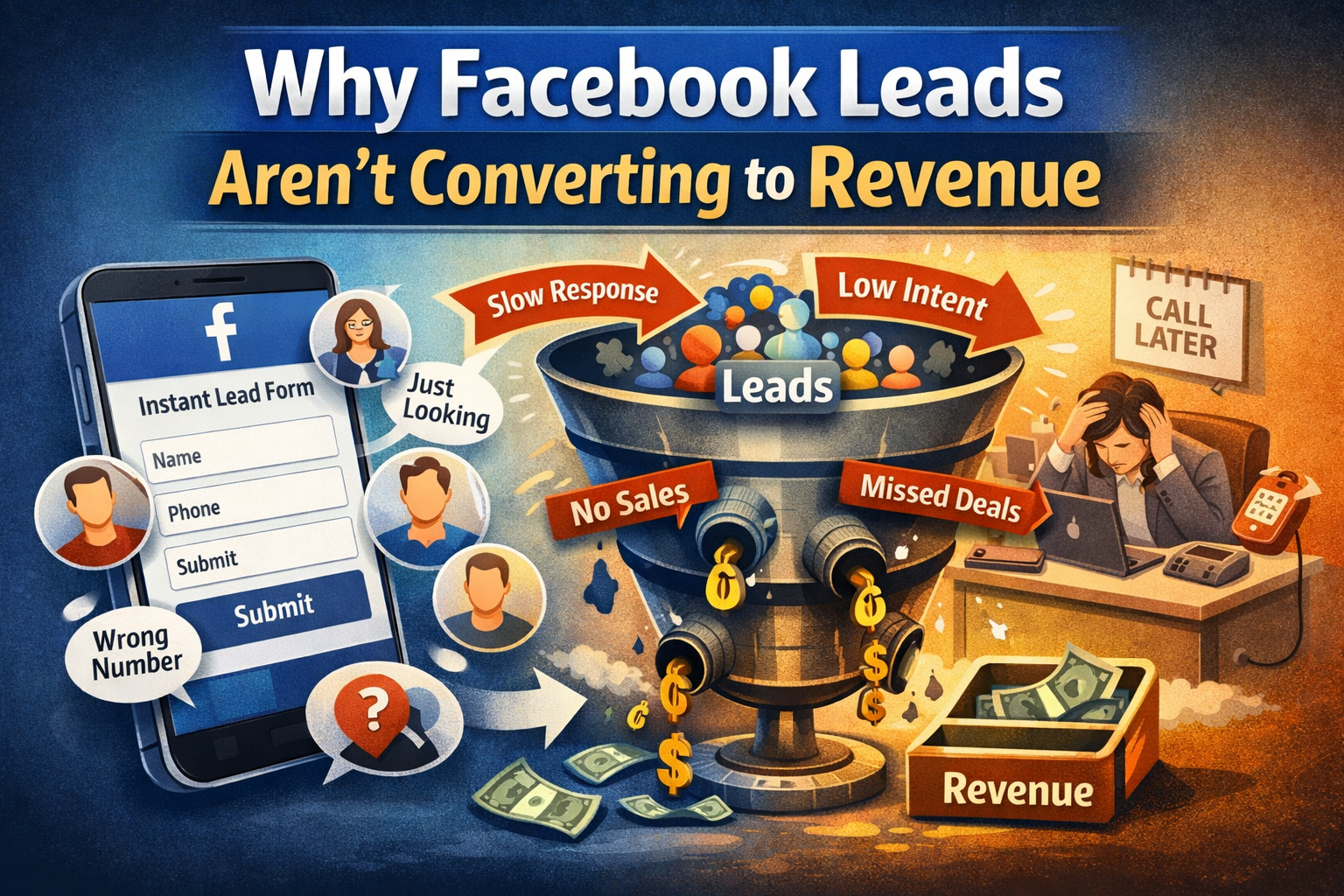
Why Facebook Leads Often Fail to Convert Into Real Revenue: A Practical Analysis for Businesses
In recent years, Facebook and Instagram have become powerful tools for generating business leads. Many companies report receiving hundreds or even thousands of enquiries through Meta’s lead generation campaigns. Yet a common frustration remains: despite strong lead numbers, actual revenue growth often falls short of expectations.
This disconnect does not usually mean that Facebook advertising has failed. Instead, it highlights a gap between lead generation and revenue conversion. Understanding this gap requires looking beyond advertising metrics and examining the entire customer journey.
1. A Lead Is Not the Same as a Buyer
Facebook’s lead generation system is designed to reduce friction. Instant forms allow users to submit their contact information within seconds, often using pre-filled data from their profiles. While this increases the number of leads, it also increases the number of low-intent enquiries.
Many users submit forms out of curiosity, early-stage research, or casual interest rather than immediate purchase intent. As a result, businesses may receive a high volume of contacts that are not ready to buy.
This creates a misleading success signal. Cost per lead may look attractive, but lead quality and buying readiness remain unclear.
2. The Critical Role of Speed-to-Lead
Research consistently shows that response time significantly affects conversion outcomes. Leads cool down rapidly after submission. Businesses that respond within minutes have a substantially higher chance of initiating meaningful conversations compared to those responding hours later.
In practice, many businesses call leads after several hours or even the next day. By then, the prospect may have contacted competitors, lost interest, or forgotten the enquiry entirely. The problem is not the lead source, but the delay in engagement.
Fast acknowledgment through calls, WhatsApp messages, or SMS significantly improves contact and conversion rates.
3. Mismatch Between Offer and Buyer Stage
Facebook advertising reaches users across different stages of the buying journey. Some are actively looking to purchase, while others are only exploring options for future decisions.
When businesses treat all leads as ready-to-buy prospects, friction occurs. Prospects who are still researching may avoid sales conversations, request only pricing information, or disengage after initial contact.
Effective funnels separate leads based on intent:
-
High-intent leads move directly into sales conversations.
-
Medium-intent leads require nurturing through information and follow-ups.
-
Low-intent leads benefit from retargeting and educational content.
Without this segmentation, conversion rates naturally decline.
4. Attribution and Tracking Limitations
Changes in digital privacy, especially following Apple’s App Tracking Transparency updates, have reduced visibility into customer journeys. A customer may see a Facebook ad, enquire later through another channel, and eventually convert offline. In such cases, Facebook may not receive credit for the sale.
This leads businesses to assume that Facebook leads are not generating revenue, when in reality attribution gaps are hiding the contribution.
Connecting offline sales data or CRM outcomes back to advertising platforms improves optimization and measurement accuracy.
5. Low-Friction Forms and Lead Quality Challenges
Low-effort submission forms often attract incomplete or unqualified enquiries. Common issues include incorrect phone numbers, non-decision makers submitting forms, or users responding without serious intent.
Adding simple qualification questions such as timeline, budget range, or service location helps filter low-quality leads before they reach the sales team. Slight friction often improves overall conversion efficiency.
6. The Sales Process as the Real Conversion Driver
In many cases, the largest revenue loss occurs after the lead is generated. Weak follow-up systems, inconsistent communication, delayed quotations, or lack of structured tracking result in missed opportunities.
Businesses frequently focus on improving advertising performance while ignoring internal conversion processes. However, advertising only fills the pipeline; sales discipline determines revenue outcomes.
A structured flow typically includes:
-
Immediate acknowledgment of enquiry
-
Rapid first contact attempt
-
Qualification of requirement
-
Scheduled next step (meeting, visit, demo)
-
Timely proposal or quotation
-
Consistent follow-up until closure
When this process is missing or inconsistent, even high-quality leads fail to convert.
Conclusion
The statement “Facebook leads do not convert into revenue” oversimplifies a more complex reality. Facebook excels at generating initial interest, but revenue depends on lead quality filtering, response speed, sales processes, and accurate measurement systems.
Businesses that align marketing with operational follow-through often discover that the issue was not lead generation itself, but the absence of a structured conversion system. When advertising, follow-up, and sales discipline work together, lead volume begins to translate into measurable business growth.

Verified Enquiries
Content team at Twig Software Solutions Private Limited
Comments (0)
No comments yet. Be the first to comment!